Explore ↗
Collect possibilities before choosing a direction.
What could the spare room become?
├─ Paid workshops
│  └─ Beginner writing sessions
├─ A quiet reading room
└─ Keep it as storage
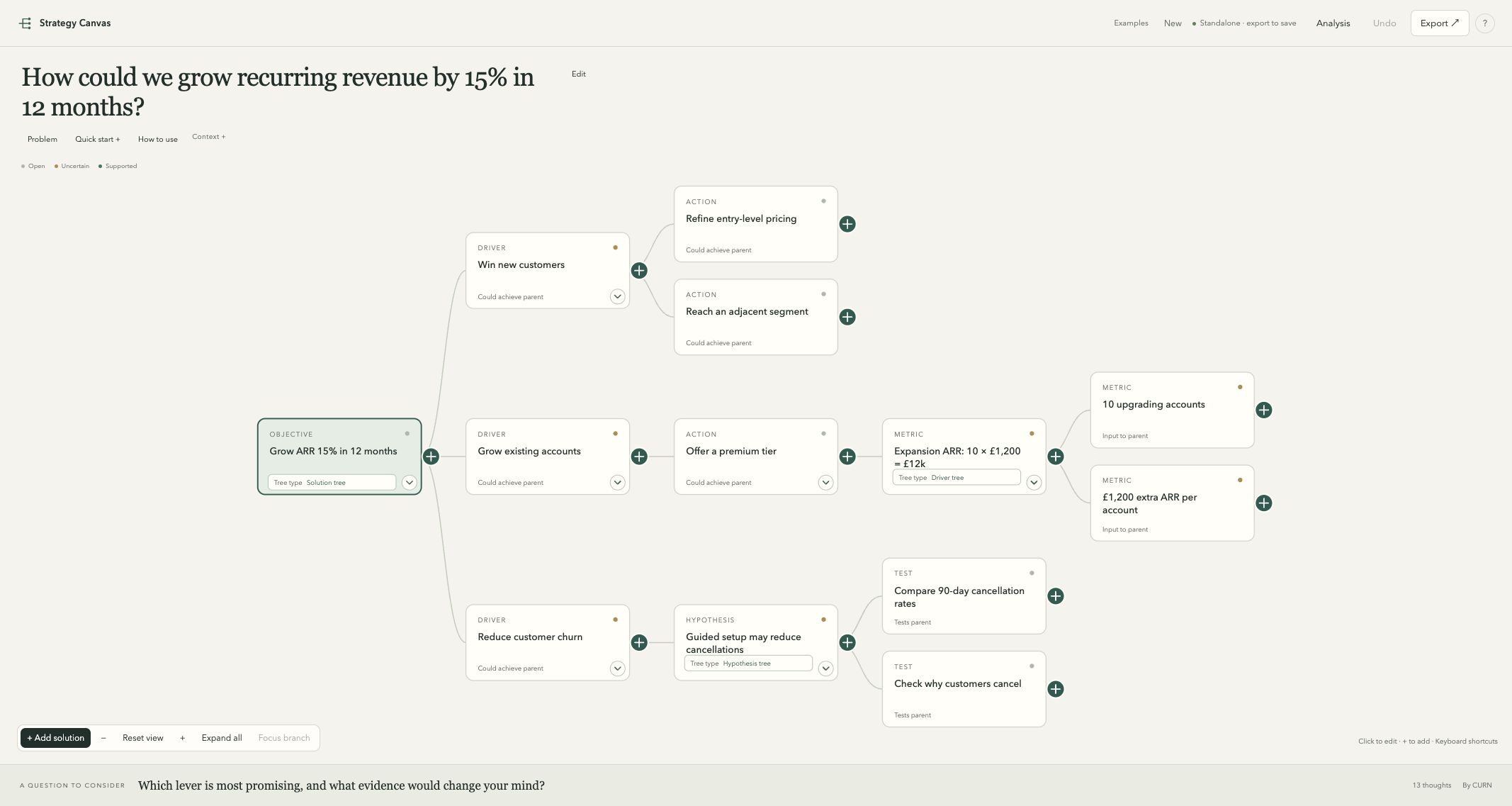
Untangle a business problem, test whether an idea pays back, or map your next move.
Open an interactive case with a guided tour, or follow the step-by-step picture guide.
Start with Grow revenue vs Decrease costs, narrow revenue to Convert more enquiries, and fix a 9-day proposal delay.
Split viability into three uniform questions (economics, demand, and 5 staff hours), with the £120 / £15 math one level below.
Every click shown with screenshots: copy the ChatGPT/Claude prompt, paste back your MECE tree, edit cards, and save a copy.
Each opens an editable example. You can mix different types in one tree.
Collect possibilities before choosing a direction.
What could the spare room become? ├─ Paid workshops │ └─ Beginner writing sessions ├─ A quiet reading room └─ Keep it as storage
Break a question into separate, non-overlapping parts.
Can a £20 workshop work for the shop?
├─ How many £20 tickets cover all costs?
│  ├─ Are fixed setup costs really <= £120?
│  └─ Does each £20 ticket leave £15 net?
├─ Will at least 8 people pay £20?
│  ├─ How many shop regulars & list readers book?
│  └─ How many new locals book via promotion?
└─ Can the room and 5 hours fit 8+ guests?
   ├─ Does the spare room seat 8 to 12 people?
   └─ Do setup, hosting, and tidy-up fit 5 hours?
Test an explanation, including what could disprove it.
Later start reduced attendance?
├─ Did the decline follow the change?
├─ Do customers report time clashes?
├─ Did old-time sessions hold up?
└─ Did topic appeal or promotion change?
Show the arithmetic behind a number.
Break-even: £120 ÷ £15 = 8 people
├─ Fixed cost: £120 per event
└─ Contribution: £20 − £5 = £15
   ├─ Ticket price: £20 per person
   └─ Variable cost: £5 per person
Connect an improvement to levers and possible actions.
Reduce Saturday queue time
├─ Fewer arrivals at peak time
│  └─ Offer quieter collection windows
├─ More peak service capacity
│  └─ Staff a second till
└─ Shorter transactions
   └─ Prepare collection orders early
Clarify what a good choice should provide.
What makes a suitable job?
├─ Financial security
│  └─ Reliable income covers commitments
├─ Autonomy
│  └─ Control over how work is done
└─ Learning
   └─ Regular practice and useful feedback
Compare choices when outcomes are uncertain.
Hold or cancel the event?
├─ Hold the event
│  └─ Attendance is uncertain
│     ├─ Strong: 60% → +£200 net
│     └─ Weak: 40% → −£100 net
└─ Cancel the event
   └─ Net payoff: £0
Connect customer needs to solutions and assumption tests.
Increase completed bookings
└─ Find a time that fits
   ├─ Flexible-date search
   │  └─ Can users find an acceptable slot?
   └─ Availability alerts
└─ Does the alert arrive in time?Show a conclusion, its reasons and the counterargument.
Try one workshop first (provisional)
├─ Recurring demand is unproven
│  └─ Interest is non-binding (assumed)
├─ A pilot can test paid uptake
├─ One event limits commitment
│  └─ No ongoing contract (assumed)
└─ One event may not predict repeats
A fictional growth question, explored with several tree types.